AI for homeschooling: plan a week and adapt the practice.
Build a weekly homeschool plan, adapt a shared activity for two learning levels and prepare practice with an answer key. Work around your family’s materials, available time and observations of each learner.
Fold one strip into two equal parts and shade one part. Fold that same strip again to make four equal parts. The shaded area now covers two of four parts, but the amount of paper has not changed.
Your follow-up
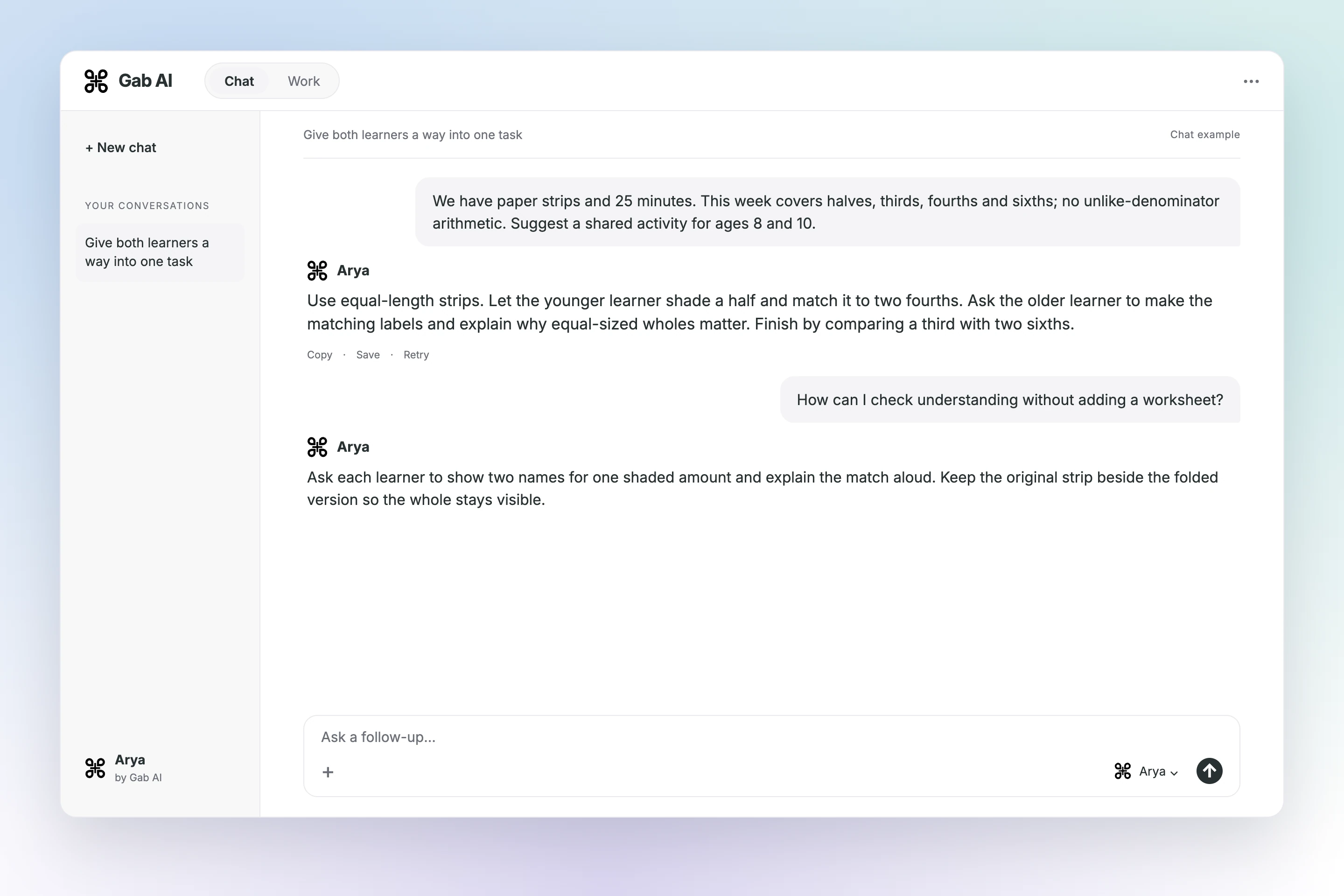
Give each learner something to do.
Arya
Ask the younger learner to point to the shaded half and count its fourths. Ask the older learner to explain why the same shaded amount can be named both 1/2 and 2/4.
Use equal-length strips. Let the younger learner shade a half and match it to two fourths. Ask the older learner to make the matching labels and explain why equal-sized wholes matter. Finish by comparing a third with two sixths.
Your follow-up
How can I check understanding without adding a worksheet?
Arya
Ask each learner to show two names for one shaded amount and explain the match aloud. Keep the original strip beside the folded version so the whole stays visible.
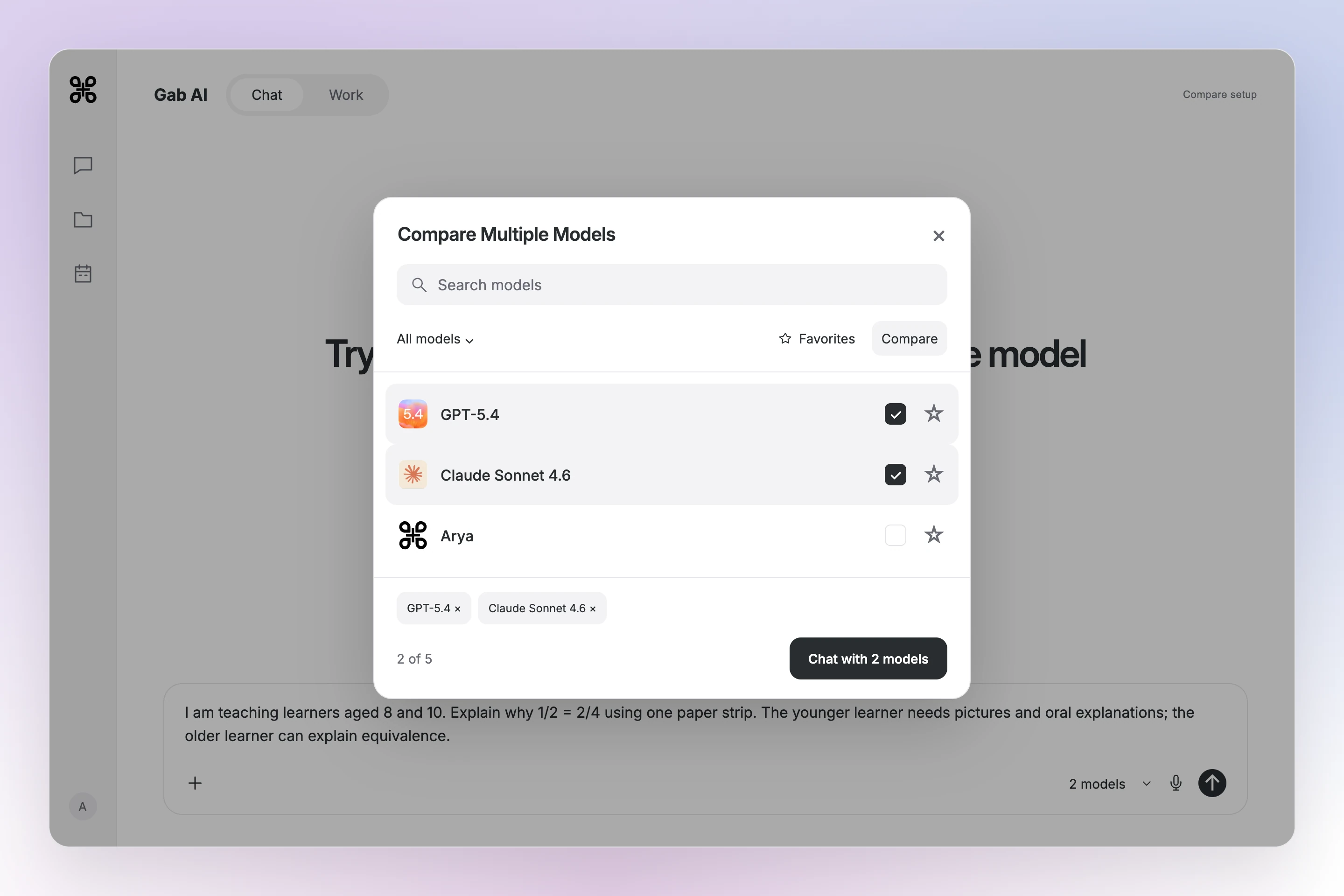
Try the same question with more than one model
Choose compatible models, compare their reasoning and decide which answer helps with your task.
In the model picker, turn on Compare and choose compatible models before sending the same prompt. Compare requires Plus; model access and credit use depend on the selection. Check facts and omissions rather than assuming a winner.
Build a weekly plan, practice sheets and learning observations
Build a manageable lesson week, inspect a practice sheet and keep a record of what each child can do.
Plan the fraction learning week
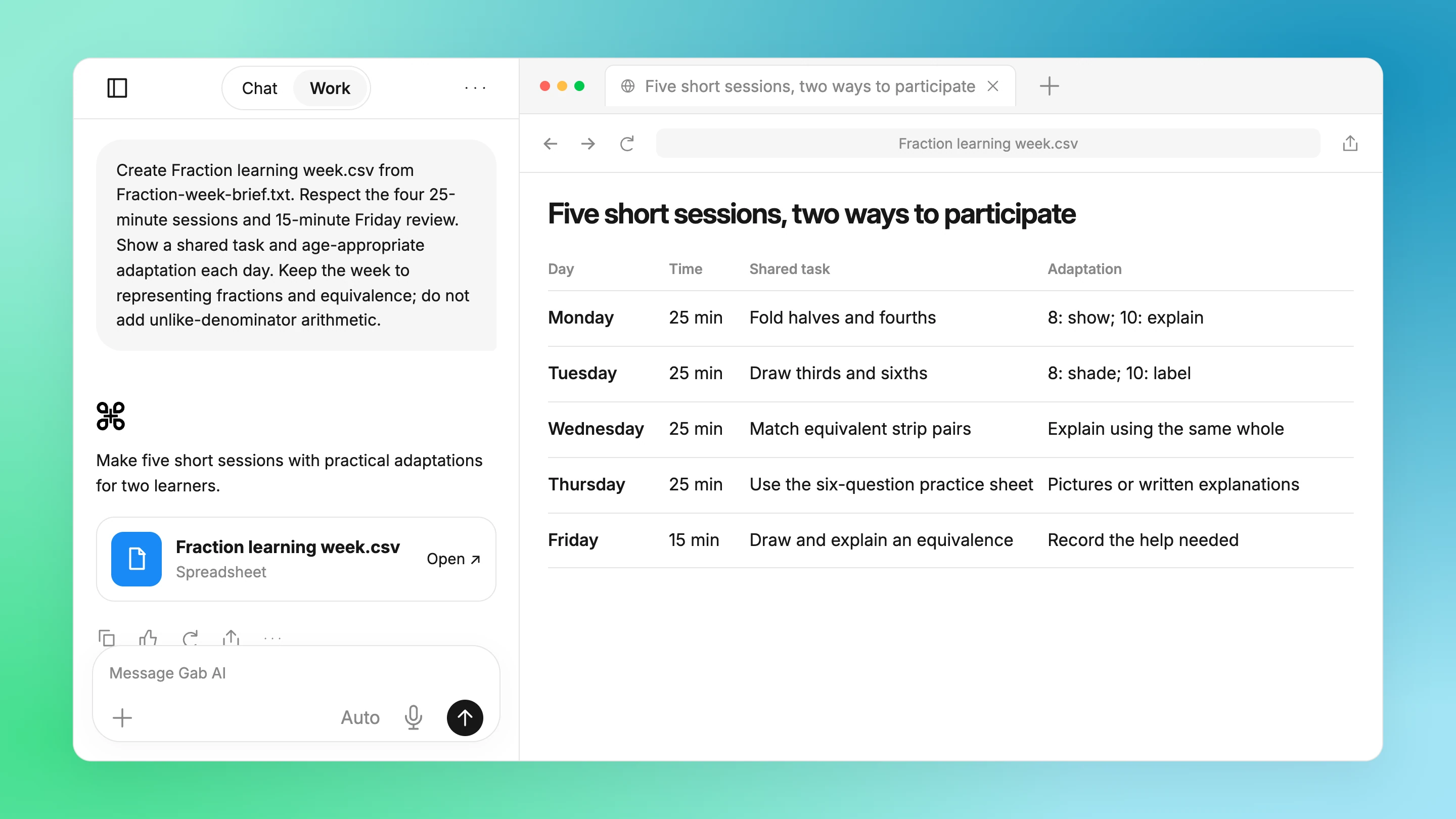
Make five short sessions with practical adaptations for two learners.
Two learners, ages 8 and 10. Four 25-minute sessions plus a 15-minute Friday review. The younger learner needs pictures and oral explanations; the older learner is ready to explain equivalence.
Learning goal
Represent halves, thirds, fourths and sixths. Recognize 1/2 = 2/4 = 3/6 and 1/3 = 2/6. Use paper strips and drawings before symbols. Do not add unlike-denominator arithmetic this week.
Practice and answers
Practice: (1) shade 1/2 of four equal boxes; (2) shade 1/3 of six equal boxes; (3) fill 1/2 = ?/4; (4) fill 1/3 = ?/6; (5) explain why 2/4 equals 1/2; (6) explain why 2/6 equals 1/3. Answers: two boxes; two boxes; 2; 2; same whole, two of four is half; same whole, two of six is one third.
Create fraction practice with an answer key
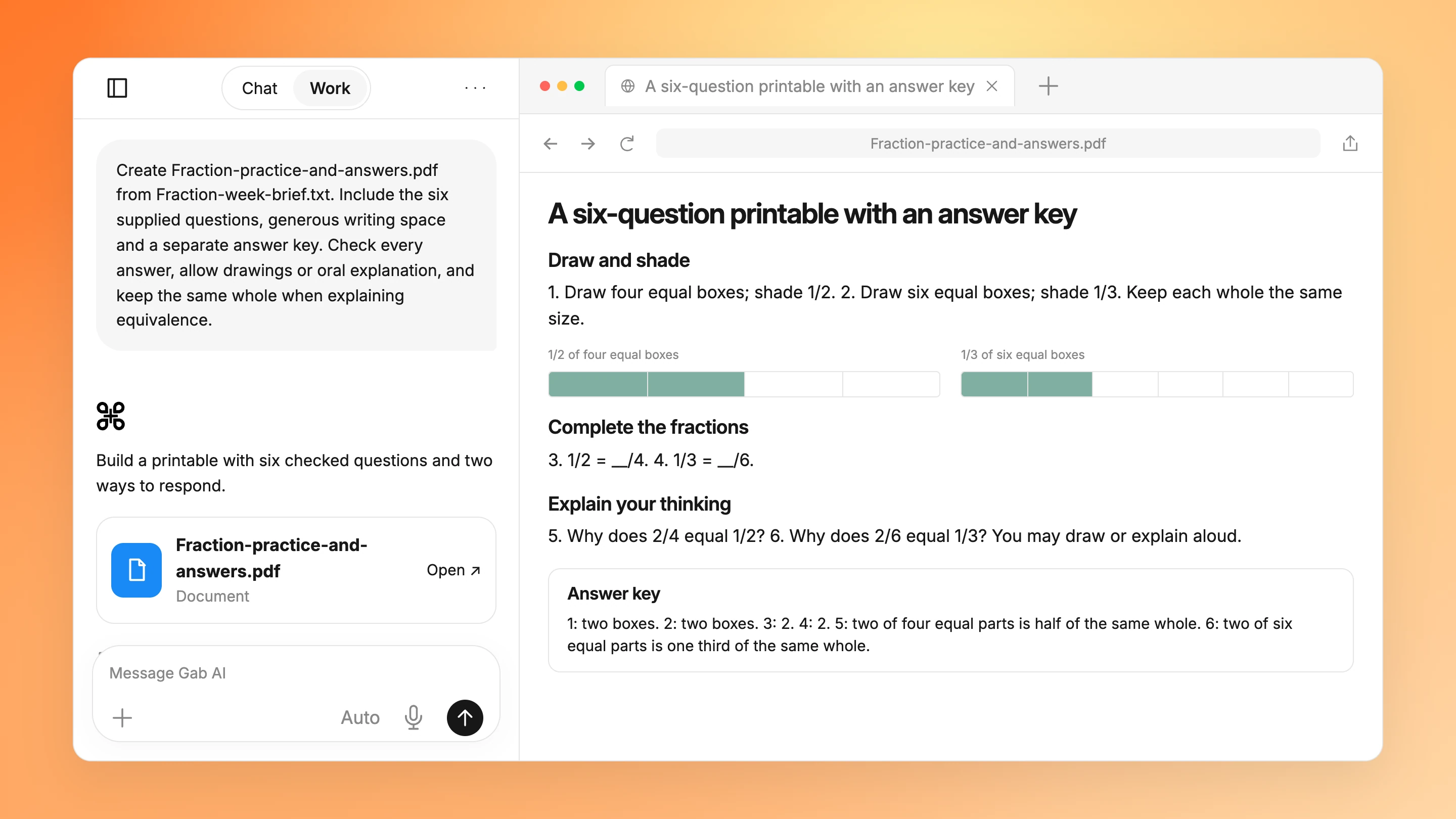
Build a printable with six checked questions and two ways to respond.
Build a printable with six checked questions and two ways to respond.
Loading…
This content could not load.
Your source material stays available.
A six-question printable with an answer key
Draw and shade
1. Draw four equal boxes; shade 1/2. 2. Draw six equal boxes; shade 1/3. Keep each whole the same size.
Fraction-week-brief.txt
View full example
Complete the fractions
3. 1/2 = __/4. 4. 1/3 = __/6.
Fraction-week-brief.txt
Explain your thinking
5. Why does 2/4 equal 1/2? 6. Why does 2/6 equal 1/3? You may draw or explain aloud.
Fraction-week-brief.txt
Answer key
1: two boxes. 2: two boxes. 3: 2. 4: 2. 5: two of four equal parts is half of the same whole. 6: two of six equal parts is one third of the same whole.
Fraction-week-brief.txt
The completed sample contains tasks and checked answers, ready to print.
Two learners, ages 8 and 10. Four 25-minute sessions plus a 15-minute Friday review. The younger learner needs pictures and oral explanations; the older learner is ready to explain equivalence.
Learning goal
Represent halves, thirds, fourths and sixths. Recognize 1/2 = 2/4 = 3/6 and 1/3 = 2/6. Use paper strips and drawings before symbols. Do not add unlike-denominator arithmetic this week.
Practice and answers
Practice: (1) shade 1/2 of four equal boxes; (2) shade 1/3 of six equal boxes; (3) fill 1/2 = ?/4; (4) fill 1/3 = ?/6; (5) explain why 2/4 equals 1/2; (6) explain why 2/6 equals 1/3. Answers: two boxes; two boxes; 2; 2; same whole, two of four is half; same whole, two of six is one third.
Check the answer, not just the worksheet
Inspect the supplied equivalences behind the answer key.
Build a fraction observation record
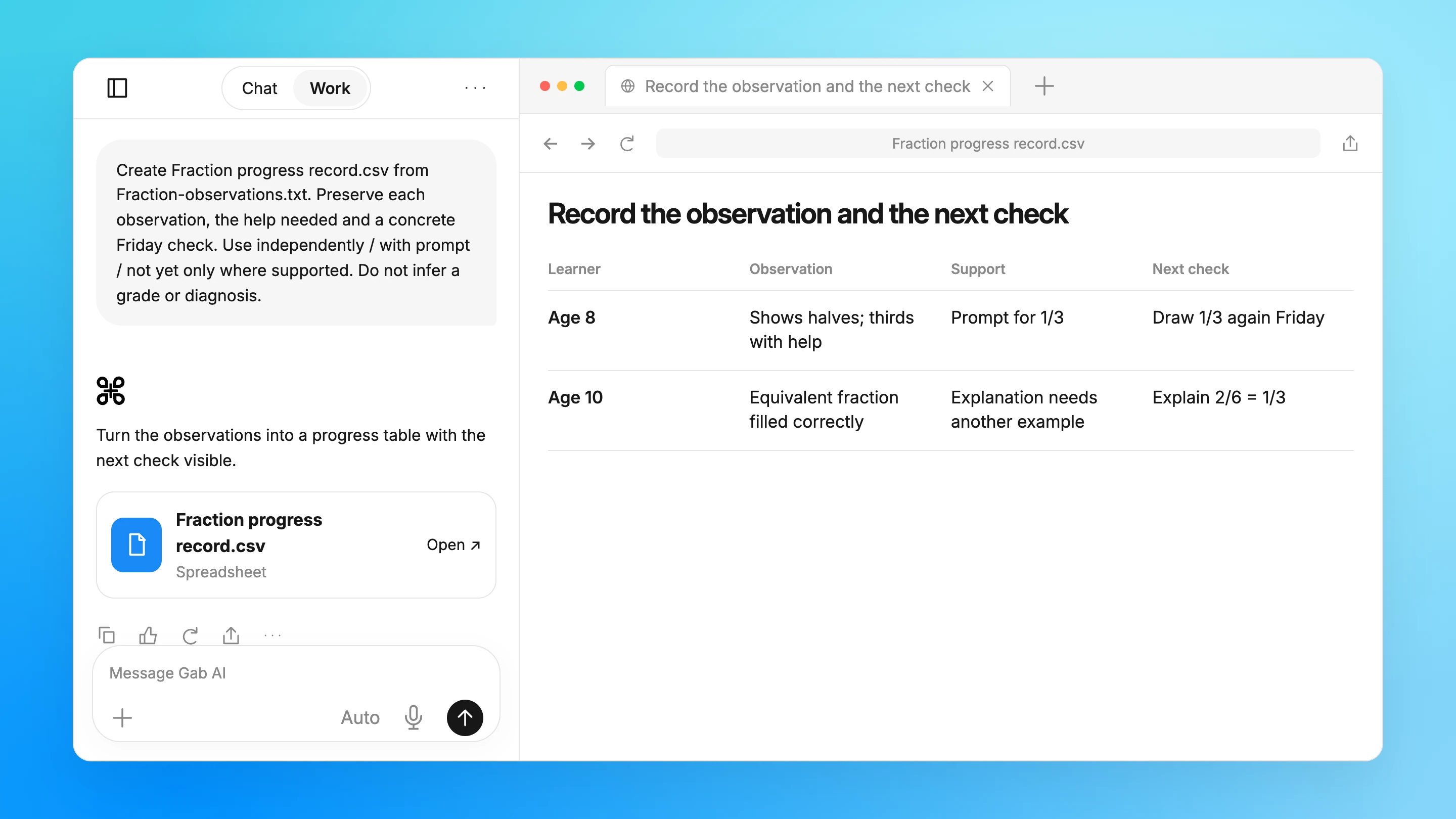
Turn the observations into a progress table with the next check visible.
Monday: shows 1/2 with paper strips independently. Tuesday: shades two of six boxes for 1/3 with a prompt.
Older learner
Monday: explains 2/4 = 1/2 using the same whole. Tuesday: fills 1/3 = 2/6 independently; verbal explanation needs another example.
Next review
Friday: ask both learners to draw equivalent fractions and explain how they know. Record independently / with prompt / not yet, without assigning a grade from these notes.
About these examples
Plan a homeschool week and adapt family activities
Explore the sample deliverables, then open the workflow to inspect their inputs and evidence.
From the first question to useful work
Refine practice around each learner’s understanding
Compare the draft with a focused revision, keeping the source facts in view.
Try one focused revision
Suggested follow-up using the same source facts.
Focused follow-up
What change should I ask for?
Make the first two exercises easy for a parent to read aloud. Preserve four boxes for halves, six for thirds and equal-sized wholes.
Original excerpt
What does the existing example say?
1. Draw four equal boxes; shade 1/2. 2. Draw six equal boxes; shade 1/3. Keep each whole the same size.
Suggested revision
What could that revision look like?
Draw two wholes of the same size. Divide the first into four equal boxes and shade one half; divide the second into six equal boxes and shade one third. Ask your child to explain the shaded parts.
Use Chat to discuss the request and refine the result with follow-up questions.
Deliverable: Activity variations
What to provide
Approved topic, learner ages, materials and available time
Example prompt
Adapt this source activity for two children at different learning levels using the materials and time I provide. Keep a shared introduction, offer separate practice and explain how I can observe understanding without comparing the children to each other.
What to check
Check the teaching sources
Try the activity yourself
Verify record requirements locally
Chat
Explain a concept with practice
A source-aligned explanation and a practice question that leaves room for the learner to respond.
Use Chat to discuss the request and refine the result with follow-up questions.
Deliverable: Explanation and practice
What to provide
Learning objective, your child's attempt and source lesson
Example prompt
Explain the concept in this lesson using one concrete example. Give a short practice question and wait for the learner's attempt before showing the answer. Keep the explanation consistent with the supplied method.
What to check
Check the teaching sources
Try the activity yourself
Verify record requirements locally
Work
Build a weekly lesson guide
A weekly lesson document with materials, learning checks and separate parent guidance.
Use Work to build and revise Weekly homeschool guide.docx from your source material.
Deliverable: Weekly homeschool guide.docx
What to provide
Selected readings, goals, learner needs and family availability
Example prompt
Create an editable weekly guide with short lessons, materials, discussion prompts and optional extensions using our supplied sources and realistic availability. Put parent answers in a separate section and label any invented example responses. Deliver "Weekly homeschool guide.docx" as the requested editable artifact. Ask for missing source material rather than inventing facts.
What to check
Check the teaching sources
Try the activity yourself
Verify record requirements locally
Work
Create a learning record workbook
A learning-record workbook separating plans from actual completed work and its supporting references.
Use Work to build and revise Learning record workbook.xlsx from your source material.
Deliverable: Learning record workbook.xlsx
What to provide
Actual completed activities, source titles and verified local requirements
Example prompt
Build a workbook for recording completed activities, dates, materials, observed learning and work-sample references. Keep planned activities separate from completed work and do not assert that the record satisfies legal or accreditation requirements. Deliver "Learning record workbook.xlsx" as the requested editable artifact. Ask for missing source material rather than inventing facts.
What to check
Check the teaching sources
Try the activity yourself
Verify record requirements locally
More fraction prompts
Work
Plan the fraction learning week
The week stays inside the supplied goal and available time.
Use Work to create and revise the editable Fraction learning week.csv with the supplied source files.
Deliverable: Fraction learning week.csv
What to provide
Fraction-week-brief.txt: Purpose-created family learning goals; no actual child records.
Example prompt
Create Fraction learning week.csv from Fraction-week-brief.txt. Respect the four 25-minute sessions and 15-minute Friday review. Show a shared task and age-appropriate adaptation each day. Keep the week to representing fractions and equivalence; do not add unlike-denominator arithmetic.
What to check
Inspect the input files and cited passages
Verify the finished result against your own facts
Revise before sharing or publishing
Work
Create fraction practice with an answer key
The completed sample contains tasks and checked answers, ready to print.
Use Work to create and revise the editable Fraction-practice-and-answers.pdf with the supplied source files.
Deliverable: Fraction-practice-and-answers.pdf
What to provide
Fraction-week-brief.txt: Purpose-created family learning goals; no actual child records.
Example prompt
Create Fraction-practice-and-answers.pdf from Fraction-week-brief.txt. Include the six supplied questions, generous writing space and a separate answer key. Check every answer, allow drawings or oral explanation, and keep the same whole when explaining equivalence.
What to check
Inspect the input files and cited passages
Verify the finished result against your own facts
Revise before sharing or publishing
Work
Build a fraction observation record
Progress entries preserve the limited evidence and do not turn two sessions into a grade.
Use Work to create and revise the editable Fraction progress record.csv with the supplied source files.
Deliverable: Fraction progress record.csv
What to provide
Fraction-observations.txt: Sample observations for a progress record, not a diagnosis or grade.
Example prompt
Create Fraction progress record.csv from Fraction-observations.txt. Preserve each observation, the help needed and a concrete Friday check. Use independently / with prompt / not yet only where supported. Do not infer a grade or diagnosis.
Can Gab AI adapt a shared activity for different learners?
Provide the topic, learner ages, materials, available time and the supports you use. Ask for related versions that share the learning goal while allowing different ways to respond. Try the activity yourself and check the explanations before teaching it.
Can I create a weekly homeschool guide in Work?
Supply the readings, goals, learner needs and family availability. Ask for sessions, materials, learning checks and separate parent guidance. Opening the prompt prepares a draft. The fraction example uses four twenty-five-minute sessions and a fifteen-minute review.
Does the fraction observation record establish a grade?
No. It records what each learner demonstrated independently or with a prompt and leaves the next check visible. A few notes do not establish full mastery or a grade. Verify teaching sources, adapt the activity and check local recordkeeping requirements separately.
How can I homeschool two children at different learning levels?
Start with a shared topic, materials and available time. The sample uses four 25-minute sessions and a 15-minute Friday review: pictures and oral explanations for the younger learner, equivalence explanations for the older. Record the help each needed and adapt the next activity; these observations do not establish a grade or diagnosis.
Can I start in Chat, or do I need Work?
Use Chat for questions and text drafts. Choose Work when you want a project with tools and editable files. Work requires Plus and uses credits; see Pricing for plans and allowances. Opening a draft does not send it or attach the example files.