AI for small business: compare costs and prepare customer materials.
Prepare customer materials, calculate a workshop budget and compare business expansion options. Bring the offer, costs and constraints into one workspace so you can work through the next decision.
Our beginner hand-building workshop is on Saturday, October 24, from 2–4 pm. It is USD 45 per person with materials included. Please contact the studio desk to check a place and arrange your booking.
Your follow-up
They asked about accessibility too.
Arya
Please let the studio desk know what access arrangements you need. The team can confirm what is available before you book.
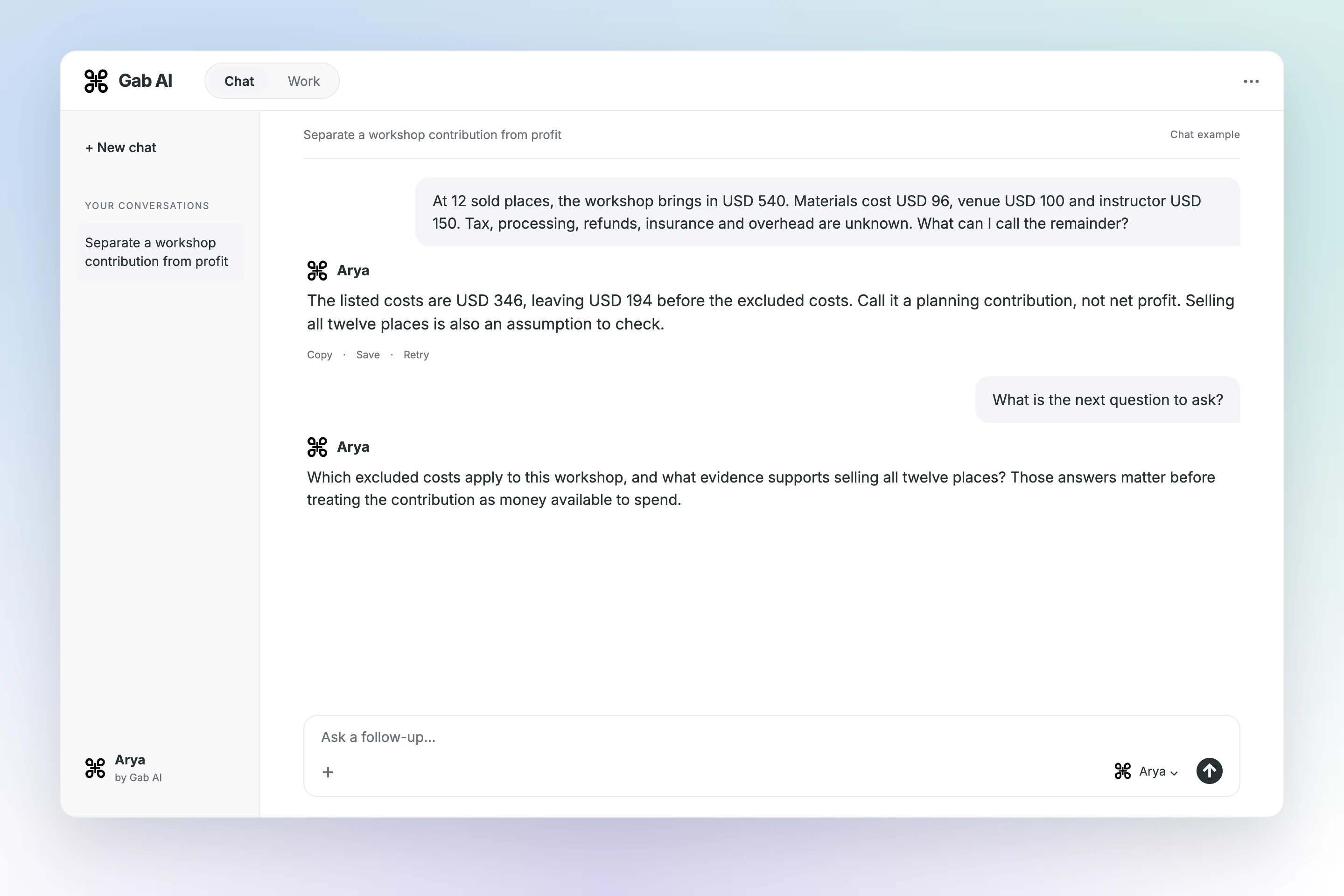
Separate a workshop contribution from profit
The listed costs are USD 346, leaving USD 194 before the excluded costs.
The listed costs are USD 346, leaving USD 194 before the excluded costs. Call it a planning contribution, not net profit. Selling all twelve places is also an assumption to check.
Your follow-up
What is the next question to ask?
Arya
Which excluded costs apply to this workshop, and what evidence supports selling all twelve places? Those answers matter before treating the contribution as money available to spend.
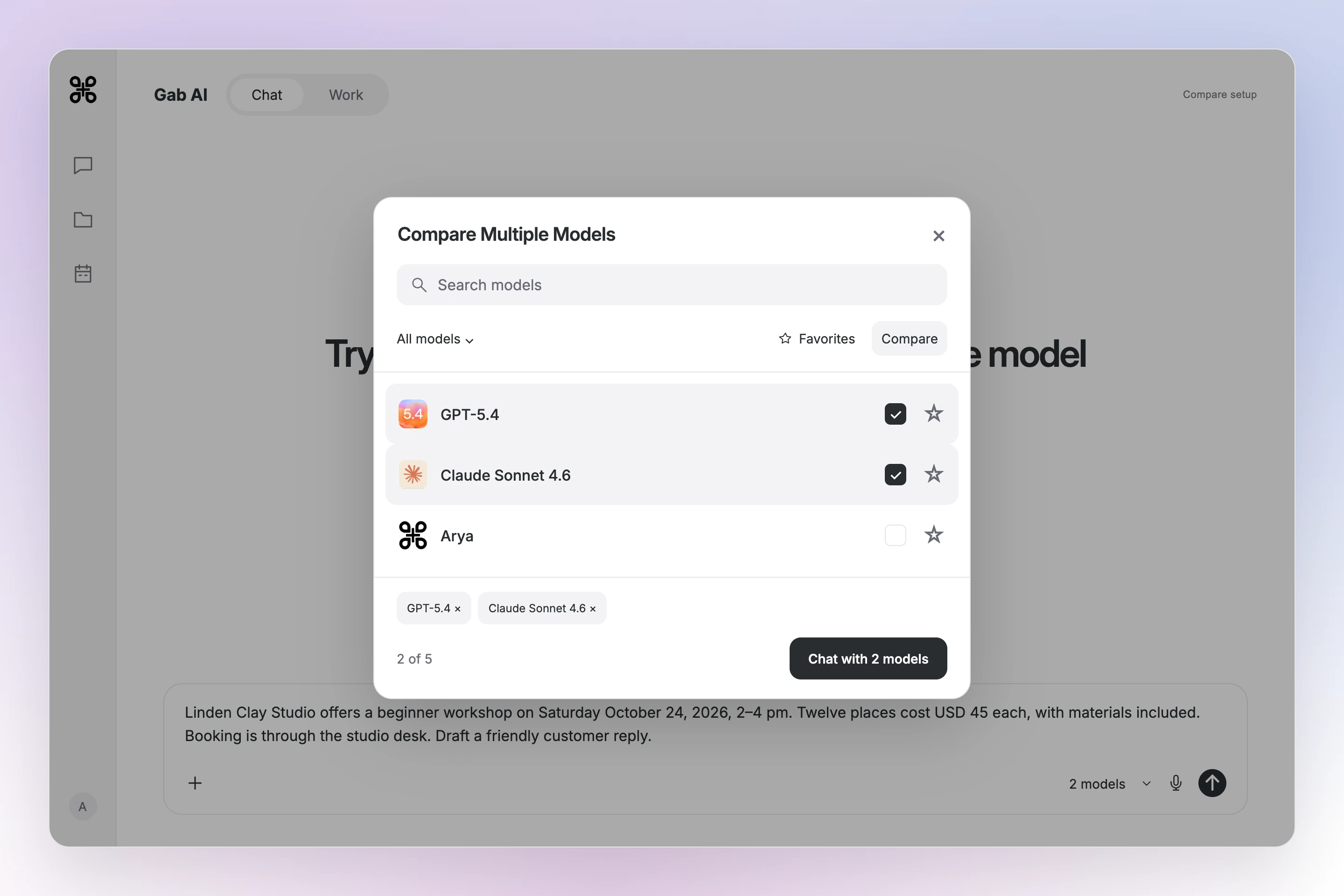
Try the same question with more than one model
Choose compatible models, compare their reasoning and decide which answer helps with your task.
In the model picker, turn on Compare and choose compatible models before sending the same prompt. Compare requires Plus; model access and credit use depend on the selection. Check facts and omissions rather than assuming a winner.
Build a customer pack and compare business options
Prepare the customer pack, check the workshop budget and test the case for a second session.
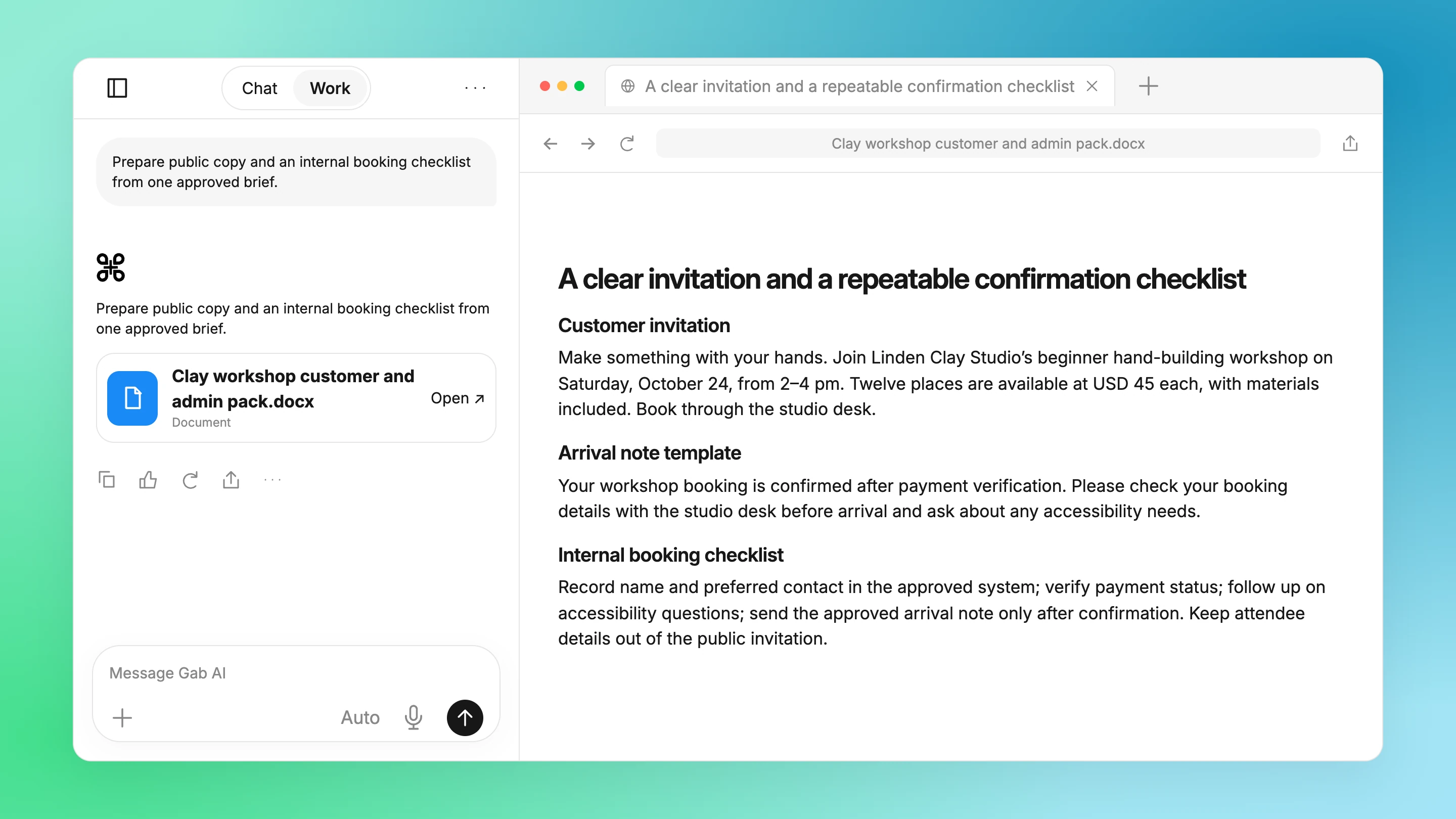
Create the workshop customer and admin pack
Prepare public copy and an internal booking checklist from one approved brief.
Prepare public copy and an internal booking checklist from one approved brief.
Loading…
This content could not load.
Your source material stays available.
A clear invitation and a repeatable confirmation checklist
Customer invitation
Make something with your hands. Join Linden Clay Studio’s beginner hand-building workshop on Saturday, October 24, from 2–4 pm. Twelve places are available at USD 45 each, with materials included. Book through the studio desk.
Clay-workshop-brief.txt
View full example
Arrival note template
Your workshop booking is confirmed after payment verification. Please check your booking details with the studio desk before arrival and ask about any accessibility needs.
Clay-workshop-brief.txt
Internal booking checklist
Record name and preferred contact in the approved system; verify payment status; follow up on accessibility questions; send the approved arrival note only after confirmation. Keep attendee details out of the public invitation.
Clay-workshop-brief.txt
Customer copy and internal steps are separated so participant details stay out of public materials.
Linden Clay Studio: beginner hand-building workshop, Saturday October 24, 2026, 2–4 pm. Twelve places at USD 45 each. Materials included. Booking is through the studio desk; no online link supplied.
Repeatable administration
Before confirming: record the attendee name, preferred contact, payment status and accessibility questions in the studio’s approved system. Send the approved arrival note after payment confirmation. Do not expose participant details in marketing materials.
Marketing direction
Warm terracotta and cream. Friendly, practical copy: Make something with your hands. Avoid claims of professional certification or guaranteed finished results.
Check the clay workshop budget
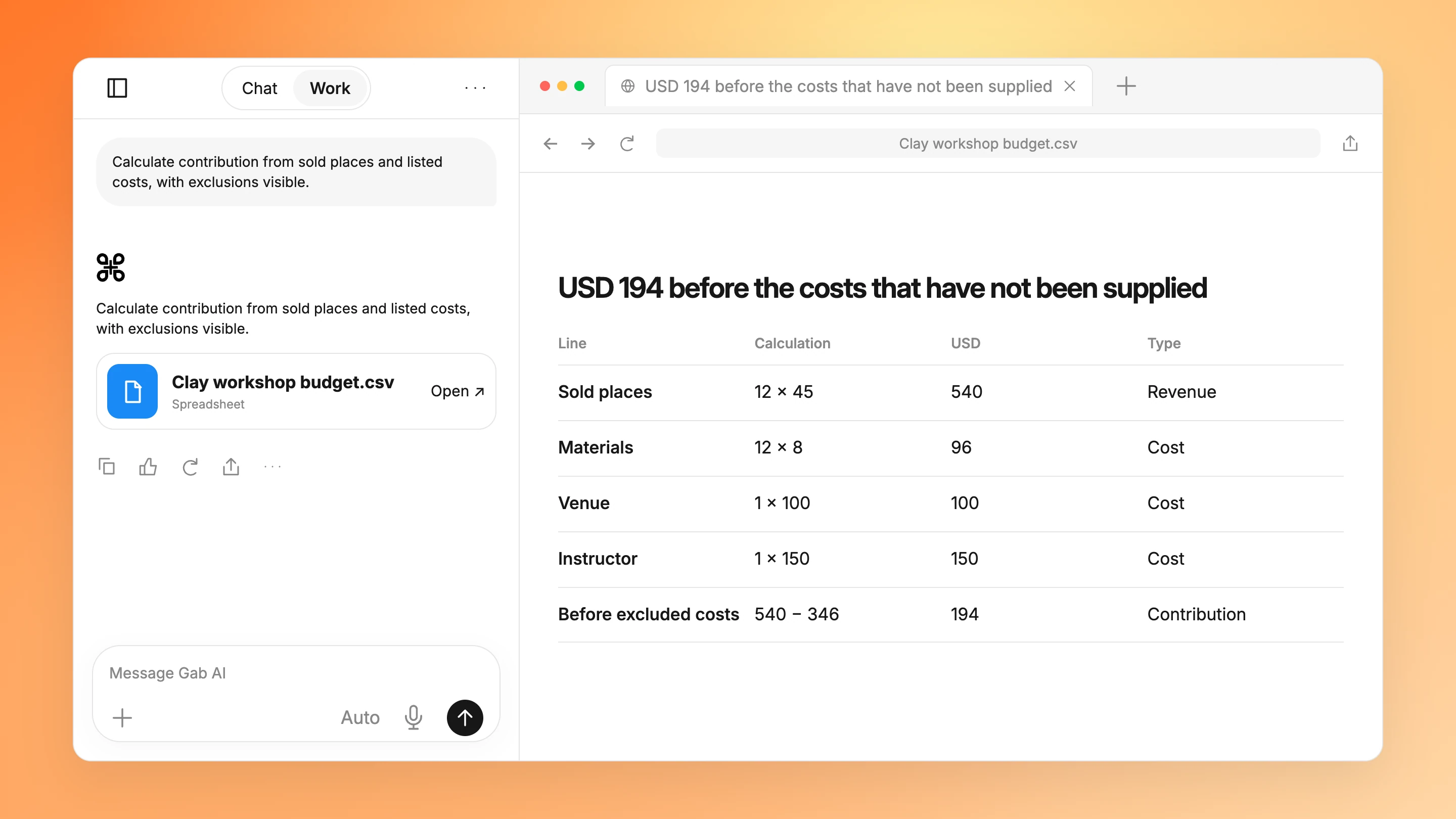
Calculate contribution from sold places and listed costs, with exclusions visible.
A second session needs more than a bigger revenue number.
About this example
Eight sold places per session
Original-only revenue is USD 360; listed costs are USD 314; contribution is USD 46. Two-session revenue is USD 720; listed costs are USD 688; contribution is USD 32. Adding the session reduces contribution by USD 14 in this scenario, before excluded costs.
Clay-studio-options.csv
Clay-studio-strategy-brief.txt
A threshold, not an approval
The added session needs nine sold places to cover USD 310 of listed fixed/coordination costs at USD 37 per place before excluded costs. Demand, availability and all excluded costs still need owner review.
Clay-studio-options.csv
Clay-studio-strategy-brief.txt
Keep the next commitment conditional
Review demand and availability before committing to a second session. Lower attendance can reduce contribution; the high-attendance scenario is neither a forecast nor permission to expand.
Clay-studio-strategy-brief.txt
Curated owner-planning example. Change assumed attendance, inspect the calculation and review the evidence needed before expansion.
Read the prompt and inspect the full example
Compare one workshop with a second session. Show how attendance changes the case for expansion.
Linden Clay Studio: beginner hand-building workshop, Saturday October 24, 2026, 2–4 pm. Twelve places at USD 45 each. Materials included. Booking is through the studio desk; no online link supplied.
Repeatable administration
Before confirming: record the attendee name, preferred contact, payment status and accessibility questions in the studio’s approved system. Send the approved arrival note after payment confirmation. Do not expose participant details in marketing materials.
Marketing direction
Warm terracotta and cream. Friendly, practical copy: Make something with your hands. Avoid claims of professional certification or guaranteed finished results.
Clay-workshop-budget.csv
Budget basis
Assume all 12 places are sold: revenue 12 × USD 45 = USD 540. Materials 12 × USD 8 = USD 96; venue USD 100; instructor USD 150. Listed costs total USD 346; contribution before excluded costs is USD 194.
Excluded costs
Tax, payment processing, refunds, insurance and general studio overhead are not supplied. The sample is a planning contribution, not net profit.
Clay-studio-strategy-brief.txt
Owner decision
Compare running the original October 24, 2026 workshop alone with adding a second equivalent session. Preserve USD 45 per place and 12-place capacity for each session. The second session has no confirmed date, venue or instructor availability. This is an owner planning decision, not an approved expansion.
Attendance assumptions
Compare 6, 8 and 12 sold places per session. For simplicity, assume equal attendance in both sessions when comparing the two-session option. These are sensitivity scenarios, not bookings, demand evidence or sales forecasts. Materials cost USD 8 per sold place; all listed fixed costs are incurred even when attendance is low.
Decision criteria
Compare total revenue, listed costs, contribution before excluded costs, incremental contribution and added capacity. Do not choose an option solely because its maximum scenario has the largest contribution. Evaluate extra coordination, demand risk and whether the venue and instructor are available.
Evidence still missing
No second-session demand, participant bookings, willingness-to-pay study, venue availability, instructor availability or alternative use of staff time is supplied. Tax, processing fees, refunds, insurance and studio overhead remain unknown. The cost comparison is not net profit or a complete business forecast.
Owner review gate
Adding the session must remain pending until the owner reviews demand, confirms venue and instructor availability, verifies costs and resolves excluded-cost assumptions. Nine additional sold places cover the second session’s listed fixed and coordination costs before excluded costs; reaching that threshold does not itself approve expansion.
Counterargument and reversible next step
A second session can reduce total listed contribution when attendance is weak and consumes additional coordination. A cautious next step is to investigate interest through the studio’s existing process and obtain availability and cost confirmations before committing. No outreach, booking, payment, schedule or publication is authorized by this sample.
Clay-studio-options.csv
Option costs
Original only: one session, USD 100 venue, USD 150 instructor and USD 0 incremental coordination. Add second session: two sessions, USD 200 venue, USD 300 instructor and USD 60 incremental coordination in total. The second-session costs are planning assumptions; availability and actual quotes are unconfirmed.
Calculation method
Revenue = sessions × sold places per session × USD 45. Materials = sessions × sold places per session × USD 8. Listed costs = materials + venue + instructor + coordination. Contribution before excluded costs = revenue − listed costs. Incremental contribution = two-session contribution − original-only contribution. The added session has USD 310 listed fixed/coordination costs and USD 37 contribution per sold place before excluded costs.
About these examples
Prepare customer materials, budgets and business plans
Check the offer, the arithmetic and the case for a new commitment.
From everyday work to the next owner decision
Create the workshop customer and admin pack
Prepare public copy and an internal booking checklist from one approved brief.
Add the confirmed offer, event brief and customer instructions before sending.
Read all source material
Clay-workshop-brief.txt
Workshop offer
Linden Clay Studio: beginner hand-building workshop, Saturday October 24, 2026, 2–4 pm. Twelve places at USD 45 each. Materials included. Booking is through the studio desk; no online link supplied.
Repeatable administration
Before confirming: record the attendee name, preferred contact, payment status and accessibility questions in the studio’s approved system. Send the approved arrival note after payment confirmation. Do not expose participant details in marketing materials.
Marketing direction
Warm terracotta and cream. Friendly, practical copy: Make something with your hands. Avoid claims of professional certification or guaranteed finished results.
Clay-workshop-budget.csv
Budget basis
Assume all 12 places are sold: revenue 12 × USD 45 = USD 540. Materials 12 × USD 8 = USD 96; venue USD 100; instructor USD 150. Listed costs total USD 346; contribution before excluded costs is USD 194.
Excluded costs
Tax, payment processing, refunds, insurance and general studio overhead are not supplied. The sample is a planning contribution, not net profit.
Clay-studio-strategy-brief.txt
Owner decision
Compare running the original October 24, 2026 workshop alone with adding a second equivalent session. Preserve USD 45 per place and 12-place capacity for each session. The second session has no confirmed date, venue or instructor availability. This is an owner planning decision, not an approved expansion.
Attendance assumptions
Compare 6, 8 and 12 sold places per session. For simplicity, assume equal attendance in both sessions when comparing the two-session option. These are sensitivity scenarios, not bookings, demand evidence or sales forecasts. Materials cost USD 8 per sold place; all listed fixed costs are incurred even when attendance is low.
Decision criteria
Compare total revenue, listed costs, contribution before excluded costs, incremental contribution and added capacity. Do not choose an option solely because its maximum scenario has the largest contribution. Evaluate extra coordination, demand risk and whether the venue and instructor are available.
Evidence still missing
No second-session demand, participant bookings, willingness-to-pay study, venue availability, instructor availability or alternative use of staff time is supplied. Tax, processing fees, refunds, insurance and studio overhead remain unknown. The cost comparison is not net profit or a complete business forecast.
Owner review gate
Adding the session must remain pending until the owner reviews demand, confirms venue and instructor availability, verifies costs and resolves excluded-cost assumptions. Nine additional sold places cover the second session’s listed fixed and coordination costs before excluded costs; reaching that threshold does not itself approve expansion.
Counterargument and reversible next step
A second session can reduce total listed contribution when attendance is weak and consumes additional coordination. A cautious next step is to investigate interest through the studio’s existing process and obtain availability and cost confirmations before committing. No outreach, booking, payment, schedule or publication is authorized by this sample.
Clay-studio-options.csv
Option costs
Original only: one session, USD 100 venue, USD 150 instructor and USD 0 incremental coordination. Add second session: two sessions, USD 200 venue, USD 300 instructor and USD 60 incremental coordination in total. The second-session costs are planning assumptions; availability and actual quotes are unconfirmed.
Calculation method
Revenue = sessions × sold places per session × USD 45. Materials = sessions × sold places per session × USD 8. Listed costs = materials + venue + instructor + coordination. Contribution before excluded costs = revenue − listed costs. Incremental contribution = two-session contribution − original-only contribution. The added session has USD 310 listed fixed/coordination costs and USD 37 contribution per sold place before excluded costs.
Prepare a customer pack
Prepare public copy and an internal booking checklist from one approved brief.
Refine a budget explanation and expansion decision
Compare the draft with a focused revision, keeping the source facts in view.
Try one focused revision
Suggested follow-up using the same source facts.
Focused follow-up
What change should I ask for?
Shorten the invitation to two sentences. Preserve the date, hours, twelve places, USD 45 price, included materials and studio-desk booking.
Original excerpt
What does the existing example say?
Make something with your hands. Join Linden Clay Studio’s beginner hand-building workshop on Saturday, October 24, from 2–4 pm. Twelve places are available at USD 45 each, with materials included. Book through the studio desk.
Suggested revision
What could that revision look like?
Join Linden Clay Studio’s beginner hand-building workshop on Saturday, October 24, from 2–4 pm. Twelve places cost USD 45 each with materials included; book through the studio desk.
Read the financial threshold alongside the conditions it cannot resolve.
Why can more revenue produce less contribution?
Eight places At eight places per session, the added session brings USD 360 revenue, USD 64 materials and USD 310 fixed/coordination costs. Its incremental contribution is USD −14. These are assumed attendance figures, not actual bookings.
Does reaching nine places approve the expansion?
Listed-cost threshold No. Nine additional sold places cover only the added session’s listed costs before excluded costs. Demand, venue/instructor availability and excluded costs must still be reviewed; expansion remains pending.
What should the owner investigate before committing?
Next commitment Check interest through the existing studio process, obtain availability and cost confirmations, and review the excluded costs. The sample does not contact customers, create bookings or approve the second session.
Use Work to create and revise the editable Clay workshop customer and admin pack.docx with the supplied source files.
Deliverable: Clay workshop customer and admin pack.docx
What to provide
Clay-workshop-brief.txt: Purpose-created workshop and administrative details.
Example prompt
Create Clay workshop customer and admin pack.docx from Clay-workshop-brief.txt. Separate the public invitation, arrival-note template and internal confirmation checklist. Preserve the date, price, capacity and studio-desk booking method. Do not invent an online link or include attendee information in public copy.
What to check
Inspect the original inputs
Verify facts, totals and assumptions
Review before sharing or publishing
Work
Check the clay workshop budget
The calculation uses 12 sold places; it does not claim net profit.
Use Work to create and revise the editable Clay workshop budget.csv with the supplied source files.
Deliverable: Clay workshop budget.csv
What to provide
Clay-workshop-budget.csv: Illustrative planning figures, excluding taxes, processing fees and overhead.
Example prompt
Create Clay workshop budget.csv from Clay-workshop-budget.csv. Show formulas or calculation steps for revenue, materials, venue, instructor and contribution. Use 12 sold places; preserve the listed exclusions and label USD 194 as contribution before excluded costs, not net profit.
What to check
Inspect the original inputs
Verify facts, totals and assumptions
Review before sharing or publishing
Chat
Prepare a strategic options brief
A strategic-options brief showing supplied costs, alternatives, dependencies, counterarguments and missing evidence.
Use Chat to question the source material and revise the response before preparing a file.
Deliverable: Response in Chat
What to provide
Strategic options, decision criteria and verified company facts
Example prompt
Prepare a strategic options brief from these approved planning notes. State the decision, alternatives, supplied costs, dependencies and uncertainties. Include counterarguments and missing evidence without inventing market forecasts or recommending an irreversible action as settled.
What to check
Verify business inputs
Test assumptions
Leadership review
Work
Compare the workshop expansion options
Test attendance assumptions before deciding whether a second session is worth investigating.
Use Work to build an inspectable decision brief from supplied costs and explicitly labeled scenarios.
Deliverable: Clay-studio-strategic-options.html
What to provide
Clay-workshop-brief.txt
Clay-workshop-budget.csv
Clay-studio-strategy-brief.txt
Clay-studio-options.csv
Example prompt
Using Clay-workshop-brief.txt, Clay-workshop-budget.csv, Clay-studio-strategy-brief.txt and Clay-studio-options.csv, create Clay-studio-strategic-options.html. Compare the original workshop with adding a second session at 6, 8 and 12 sold places per session. Make scenario controls and Compare options/Decision brief views work. Show revenue, materials, listed fixed costs, contribution before excluded costs and incremental contribution with calculation steps. Preserve USD 45, USD 8 and 12-place capacity. Keep scenario assumptions, unconfirmed demand and availability, excluded costs, counterarguments and owner approval visible. Calculate the added-session listed-cost threshold without treating it as expansion approval. Do not forecast sales, claim net profit, send outreach, book, schedule or publish. Deliver a self-contained interactive HTML decision brief.
What to check
Verify demand and cost assumptions
Confirm availability and excluded costs
Keep expansion pending until owner review
More prompts
Chat
Reply to a customer complaint
A customer reply draft that stays within the owner's approved facts and resolution options.
Use Chat to discuss the request and refine the result with follow-up questions.
Deliverable: Customer reply draft
What to provide
An anonymized complaint and your approved resolution options
Example prompt
Draft a calm reply to this anonymized complaint. Acknowledge the specific issue, explain only the supplied resolution options and identify information I need to confirm. Do not promise a refund, deadline or policy exception I have not approved.
What to check
Verify business facts and costs
Approve customer-facing wording
Keep private customer data out
Chat
Compare a business purchase
A purchase comparison with explicit cost boundaries and questions to resolve with suppliers.
Use Chat to discuss the request and refine the result with follow-up questions.
Deliverable: Decision comparison
What to provide
Supplier offers, intended use, budget and requirements
Example prompt
Compare these supplier offers against my actual requirements and budget. Show included costs, exclusions, delivery assumptions and unanswered questions. Do not call a quote the total cost when tax, setup or ongoing fees are missing.
What to check
Verify business facts and costs
Approve customer-facing wording
Keep private customer data out
Work
Build a cash planning workbook
An editable cash workbook with transparent assumptions, formulas and a test case to check.
Use Work to build and revise Small-business cash plan.xlsx from your source material.
Deliverable: Small-business cash plan.xlsx
What to provide
Current cash, anonymized expected receipts and confirmed expenses
Example prompt
Create a workbook separating cash inputs, expected receipts, confirmed expenses and optional spending. Include running balance formulas and a clearly test row for validation; do not forecast sales without supplied assumptions or connect to financial accounts. Deliver "Small-business cash plan.xlsx" as the requested editable artifact. Ask for missing source material rather than inventing facts.
What to check
Verify business facts and costs
Approve customer-facing wording
Keep private customer data out
Work
Build a business website draft
A reviewable business website prototype and source file, with unsupported form behavior clearly identified.
Use Work to build and revise Business website.html from your source material.
Deliverable: Business website.html
What to provide
Approved business facts, services, contact details and asset rights
Example prompt
Create a responsive standalone website using my approved services, contact details and permissioned images. Mark any form as a prototype unless a working service is explicitly supplied. Deliver a preview and source; do not publish or collect customer information automatically. Deliver "Business website.html" as the requested editable artifact. Ask for missing source material rather than inventing facts.
What to check
Verify business facts and costs
Approve customer-facing wording
Keep private customer data out
Work
Create two clay workshop marketing directions
Editorial layout concepts retain the real sample date, price and booking method.
Clay-workshop-brief.txt: Purpose-created workshop and administrative details.
Example prompt
Create Clay workshop marketing directions.png from Clay-workshop-brief.txt. Make two clean visual directions with terracotta and cream, the approved date and offer, and the studio-desk booking method. Do not add certification claims, finished-result guarantees or fabricated registration links.
Can Gab AI help compare strategic options for a small business?
Supply the decision, alternatives, actual costs and constraints. Work can create an interactive brief that compares scenarios and keeps calculations, missing evidence and approval conditions visible. The workshop example compares one session with adding another; its attendance assumptions are not forecasts, and its contribution excludes unprovided costs. Verify demand and availability before committing.
Can I build a cash-planning workbook in Work?
Supply current cash, expected receipts, confirmed expenses and optional spending. Ask for running-balance formulas, visible assumptions and a test case you can check. Opening the prompt does not connect financial accounts or start a forecast.
Does the workshop budget show net profit?
No. Assuming all twelve USD 45 places sell gives USD 540 revenue. The listed USD 346 costs leave USD 194 contribution before excluded costs. Tax, processing, refunds, insurance and general overhead are not supplied. Use the scenarios to inspect assumptions, not as a sales forecast or approval to add a session.
What should I check before using the business examples?
Verify the offer, cost inputs and approval authority. The workshop budget assumes all twelve places sell and shows contribution before excluded costs, not net profit. Keep participant details out of public materials and review the strategic assumptions before making a commitment.
How can Gab AI help me reply to a customer complaint?
Give Chat an anonymized complaint and your approved resolution options. Ask for a calm reply that acknowledges the issue, stays within those options and identifies facts you need to confirm. Review it before sending; do not add an unapproved refund, deadline or policy exception.
How does Site publishing fit this workflow?
Publish the reviewed site yourself and manage its public link in My Sites; confirm contact details first.
Can I start in Chat, or do I need Work?
Use Chat for questions and text drafts. Choose Work when you want a project with tools and editable files. Work requires Plus and uses credits; see Pricing for plans and allowances. Opening a draft does not send it or attach the example files.
How can I estimate the break-even attendance for a workshop?
Supply the fixed event costs, ticket price and variable cost per attendee. Divide fixed costs by the ticket price minus the variable cost per attendee, then round up to a whole place. If the ticket price does not exceed that variable cost, this model has no finite break-even attendance. Compare the result with capacity and keep omitted costs visible. The budget example shows contribution; it does not establish complete break-even attendance.